
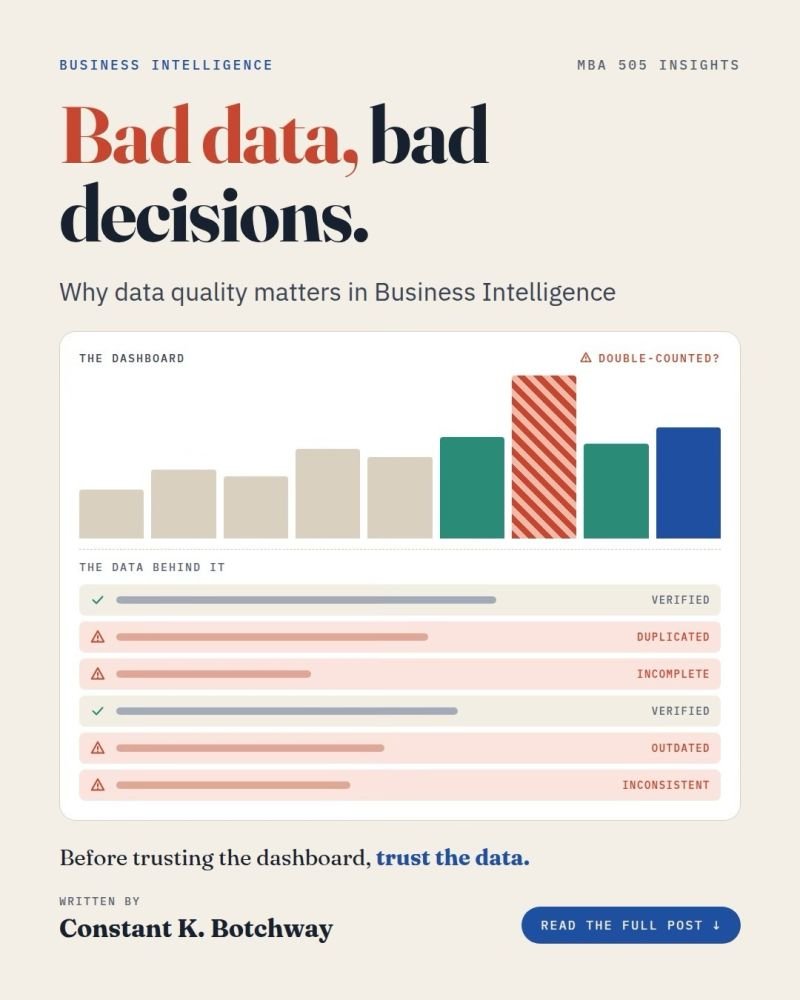
A dashboard can look impressive and still lead management in the wrong direction.
Why? Because Business Intelligence is only as reliable as the data behind it.
During my studies in Business Intelligence, one lesson became increasingly clear: organisations often invest heavily in dashboards, analytics, and visualisation while paying too little attention to the quality of the underlying data.
If the data is incomplete, duplicated, outdated, inconsistent, or simply wrong, the insight produced will also be unreliable.
WHAT IS DATA QUALITY?
Data quality refers to the extent to which data is accurate, complete, consistent, timely, relevant, and suitable for its intended purpose.
Batini and Scannapieco explain that dimensions such as accuracy, completeness, consistency, and timeliness are central to determining whether data can support effective decision-making (Batini and Scannapieco 2016).
Consider a retail company analysing customer behaviour. If one customer appears several times under different names, transactions are missing, or locations are wrongly recorded, the dashboard may produce misleading conclusions. The chart may be attractive. The decision may still be wrong.
WHEN BAD DATA BECOMES A MANAGEMENT PROBLEM
Poor data quality is not merely an IT issue. It becomes a management problem. A logistics company may wrongly identify one region as its worst-performing area because delivery records were entered incorrectly.
A university may misread enrolment trends because student records are duplicated. A business may overestimate sales because transactions were counted twice.
Sharda, Delen, and Turban argue that Business Intelligence creates value when reliable data is transformed into useful information for managerial decision-making (Sharda, Delen, and Turban 2018).
This means organisations must clean, validate, standardise, and review data before relying on dashboards and analytics.
START WITH THE DATA, NOT THE DASHBOARD
Good Business Intelligence therefore requires data governance, clear definitions, consistent data-entry procedures, and accountability for data quality.
Kimball and Ross emphasise that dependable analytical systems require disciplined structures for organising and integrating organisational data (Kimball and Ross 2013).
CONCLUSION
Business Intelligence cannot turn poor data into good decisions.
Sophisticated analytics built on unreliable data can simply produce sophisticated mistakes.
Before trusting the dashboard, organisations must first trust the data.
REFERENCES
Batini, Carlo, and Monica Scannapieco. 2016. Data and Information Quality. Springer.
Kimball, Ralph, and Margy Ross. 2013. The Data Warehouse Toolkit. 3rd ed. Wiley.
Sharda, Ramesh, Dursun Delen, and Efraim Turban. 2018. Business Intelligence, Analytics, and Data Science. 4th ed. Pearson.