
“Where two or three are gathered in my name, I am there among them” (Matt. 18:20). Matthew 18:20 is often quoted when only a few people attend a prayer meeting: “We may be few, but Jesus is here.”
That is a true Christian affirmation. But is small attendance what Jesus was actually addressing?
THE CONTEXT
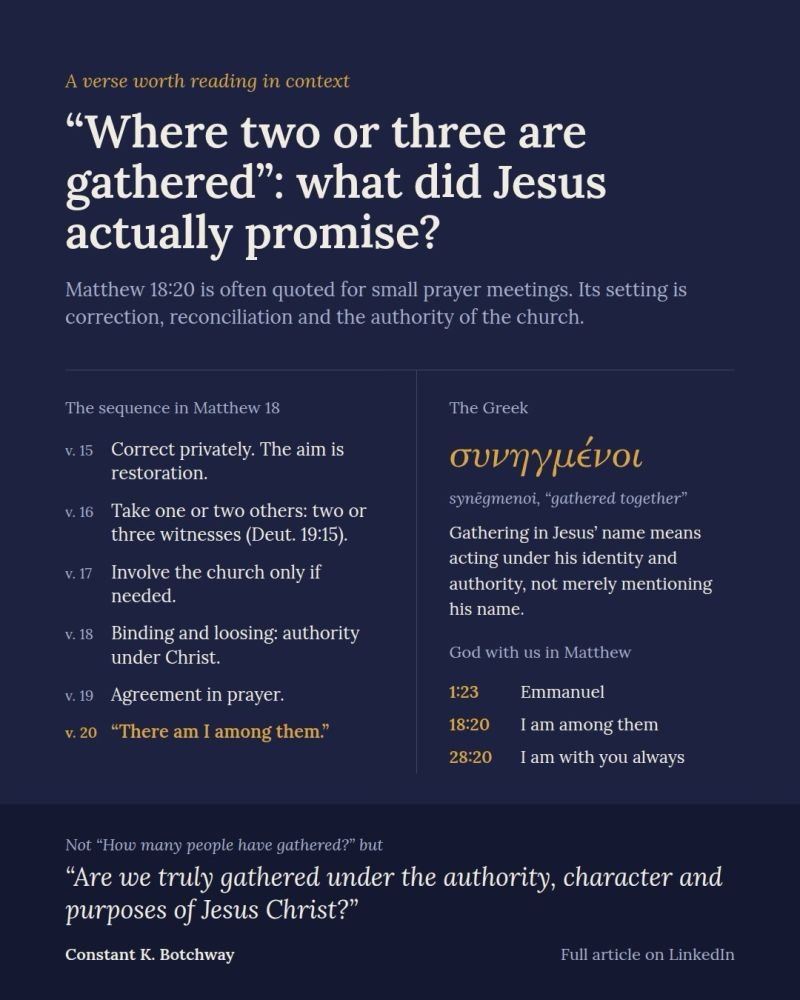
Matthew 18:15–20 concerns sin, correction, reconciliation, and responsibility within the Christian community.
Jesus first instructs a believer to address an offending brother or sister privately. The goal is restoration: “you have regained that one” (Matt. 18:15).
If the person refuses to listen, Jesus says to take “one or two others” so that the matter may be established by “two or three witnesses” (Matt. 18:16), reflecting Deuteronomy 19:15.
Jesus then speaks about the church, binding and loosing, agreement in prayer, and finally the presence of Christ among “two or three.”The “two or three” of verse 20 therefore naturally recalls the witnesses of verse 16. Keener reads the passage within the setting of correction, restoration, and communal discernment (Keener 1999).
WHAT DOES THE GREEK SAY?
The key word is: συνηγμένοι (synēgmenoi). It comes from συνάγω (synagō), meaning “to gather” or “bring together.”
Parsing:
Perfect passive participle, nominative masculine plural. The perfect tense describes a completed gathering with a continuing result. The passive voice indicates that the people have been gathered, while the plural form agrees with the “two or three.”
Jesus says they are gathered εἰς τὸ ἐμὸν ὄνομα (eis to emon onoma), commonly translated “in my name.” This means more than mentioning Jesus’ name. It describes people gathered under His identity, authority, and lordship.
France and Hagner therefore treat Matthew 18:15–20 as a connected passage involving discipline, prayer, communal authority, and Christ’s presence (France 2007; Hagner 1995).
CONCLUSION
Matthew 18:20 is not primarily about low church attendance. Jesus promises His presence as His people seek reconciliation, accountability, prayer, and faithful communal judgment under His authority.
We may apply the verse to small Christian gatherings, but its deeper question is: Are we truly gathered under the authority and purposes of Jesus Christ?
REFERENCES
France, R. T. 2007. The Gospel of Matthew. Eerdmans.
Hagner, Donald A. 1995. Matthew 14–28. Word Books.
Keener, Craig S. 1999. A Commentary on the Gospel of Matthew. Eerdmans.